 |
| scene from Elysium |
Paul Cook’s article “When Science Fiction Is Not Science
Fiction” in Amazing Stories (Sept 4, 2013) and the prolific commentary it generated, got me thinking again about our evolving perceptions of what science fiction
is, what it isn’t, what its role in literature is, and how it is generally
perceived by both SF and non-SF readers. This article couldn’t have come at a
better time either: This fall and winter I’ll be teaching my first semester at
George Brown College and University of Toronto on how to write science fiction.
And it’s aptly on the heels of a new award Amazing Stories has just created:
the Excellence in SF Denialism Award (see September 8, 2013 post in Amazing
Stories).
Cook proclaimed that he’s “too old to put up with
indulgences by books claiming to be one thing, but are really something else.”
He gave examples of various authors who, in his opinion, were really writing
another genre (usually romance) and were calling it science fiction. He called Gene Wolfe’s series The Book of the New Sun a Medieval/Arthurian
fantasy—not science fiction. He described Lois McMaster Bujold as a closet
romance writer and called her military SF Miles
Vorkosigan series romance at its core—not science fiction. Is this a fair
assessment? When does science fiction with romance turn into romance with SF
elements?
Let’s start off with what science fiction isn’t.
Science Fiction Is
Not Escapist Literature

Cook suggested that SF is an “escapist genre”. Good science fiction
is, in fact, quite the opposite. I stress “good” science fiction. Of a surety,
all genres contain escapist works. But for the sake of this argument, I speak
of that which best represents the genre.
It
is a profound mistake to interpret the genre of science fiction literally. Science
Fiction is both “the great modern literature of metaphor and pre-eminently the
modern literature not of physics but of metaphysics,” says Australian scholar
and critic Peter Nicholls. Science fiction has been referred to as the
literature of “idea”, of “the large”, and of “change & transformation”. How
does science fiction achieve this great scope? It does so through metaphor.
Science Fiction is the
Literature of Allegory & Metaphor
In
an article in the June 2005 The Guardian
entitled “Why We Need Science Fiction”, Margaret Atwood submits that science
fiction explores the relationship of humanity to the universe. It is “an
exploration that often takes us in the direction of religion and can meld easily
with mythology,” says Atwood who cites the obvious religious allegories of Star
Wars and The Matrix. Author
Brian Ott reminds us that it is not what the aliens are but what they represent
that matters. Good science fiction is allegory.

Literature in
general has always served as a cultural reporter on themes important to
humanity. The science fiction genre—and speculative fiction
particularly—explores premise based on current scientific and technological
paradigms. What if we kept doing this?…What if that went on unchecked?… What if
we decided to end this?… These are conveyed through the various predictive
visions from cautionary tales (e.g., Atwood’s Oryx and Crake) to dystopias
(e.g., Huxley’s Brave New World). Where
realist fiction makes commentary on our current society, science fiction takes
that commentary into the realm of consequence by showing it to us in living
colour. This is its power over contemporary fiction and why, I think,
mainstream literary authors like Margaret Atwood have discovered and embraced
this genre (her latest three books are all science fiction). Science fiction
doesn’t just “tell us”; it can “show us”.
In
science fiction, science provides the premise and fiction explores the answer. Themes like
achieving forgiveness, love & compassion, overcoming fear, taking control
of one’s fate & fulfilling one’s destiny, etc. are often played out through
the encounter of—and often clash with—“the other.” The “other” may be aliens, peoples
of a different culture, some new technology, a fantastical unknown entity, or a
place with strange powers. In the end, the POV characters must overcome their
own darkness, reflected in “the other” to ultimately prevail.
In Neill
Blomkamp’s District 9 set aptly in an alternate present-day Johannesburg, in
which visiting
 aliens have been incarcerated within filthy ghettos, the heroic
journey of the ordinary human WIkus van de Merwe reflects the global journey of
humanity in reaction to the “other”.
aliens have been incarcerated within filthy ghettos, the heroic
journey of the ordinary human WIkus van de Merwe reflects the global journey of
humanity in reaction to the “other”.
Blomkamp’s metaphors to our jaded history of prejudice and racism are clever and vary from the subtle to the obvious. While many viewers saw no further than the thrilling elements of the movie—alien visitation; kick-ass weapons and cool creatures getting blown up—District 9 conveyed a powerful allegory that asks unsettling questions about colonial powers. Critic Frederic Jameson reiterates, “Science Fiction is in its very nature a symbolic meditation on history itself.”

Blomkamp’s metaphors to our jaded history of prejudice and racism are clever and vary from the subtle to the obvious. While many viewers saw no further than the thrilling elements of the movie—alien visitation; kick-ass weapons and cool creatures getting blown up—District 9 conveyed a powerful allegory that asks unsettling questions about colonial powers. Critic Frederic Jameson reiterates, “Science Fiction is in its very nature a symbolic meditation on history itself.”
Science Fiction is Subversive
Literature
Oscar Wilde once
said: “Art is individualism, and individualism is a disturbing and
disintegrating force. There lies its immense value. For what it seeks is to
disturb monotony of type, slavery of custom, tyranny of habit, and the
reduction of man to the level of a machine.” Susan Sontag said, “Real art makes
us nervous.” For me, that is what science fiction does: it examines our world
and presents us with new perspectives to ponder, and evolve from. Without
darkness to contrast it, light cannot be recognized for its virtues, nor can it
even be properly seen; darkness is the platform from which light emerges in all
its glory. I’m not just talking about good and evil. Metaphorically, darkness
represents anything within us that is repressed, that we’re ashamed of or
uncomfortable with. It is the unknown—and the stuff of science fiction.
Science
fiction illuminates our history and our very humanity. It does this by
examining our interaction with “the other”, the unfamiliar. A new relationship.
A stranger in town. A scientific discovery. A clash of cultures. An alien
encounter. How do we react? Is it with fear? Wonder? Curiosity?

Good
SF accurately takes the premise of real science and explores it to the realm of
possibility and consequence. This genre, more than any other, gives us the
opportunity to look at what may be, how we get there and what happens to us as
a result. Think of the writings of Greg Bear, Robert J. Sawyer, Robert Wilson,
Kay Kenyon, William Gibson, Robert Silverberg, Isaac Asimov, Stanislav Lem, and
Ray Bradbury (to name some of my own favorites). The SF writer is both herald
and conscience of science and humanity. We are commentators of the present and
reporters of the future. Science fiction is subversive literature.
Science Fiction is the Literature of
Change & Transformation
Science fiction
is a genre of global examination and evolution. It explores humanity’s own
identity, our values and our evolution by showing how we react to change and
the unknown. Science fiction postulates and extrapolates. It takes a plausible
premise (idea) and runs with it. In most science fiction something significant
happens, is discovered or is revealed that is science-based and has profound
effects on the world—See John Wyndham’s The
Chrysalids, Isaac Asimov’s I, Robot,
Ray Bradbury’s Martian’s Chronicles,
Robert J. Sawyer’s Calculating God,
Nina Munteanu’s Darwin’s Paradox
(apologies–I just had to throw that one in!). The events, actions or
discoveries throw the main protagonist and his/her world off balance into a
full-tilt journey of self-discovery (the classic hero’s journey). Science
fiction is the transformative literature of change.
Science
Fiction is the Literature of Relationship

All great
literature distills its art form through the exploration of relationship: our
relationship with technology, with science, nature, God, our children, each
other, our history, our destiny, etc. etc. etc. Story happens when character
intersects with issue (plot and theme). Without characters and without a world
for them to interact with in ways that illuminate some thematic issue, there
would be no story and no one to empathize with.
What better art form
than the “love story” to discover our humanity. It is through love—in all its
facets—that we find passion, courage, direction and meaning in life. And there
are as many different forms of love as there are love stories: romantic love,
platonic love, altruistic love, heroic love, maternal love, filial love, charitable
love, divine love, unconditional love, and so on.
The greatest love
stories also tell of hardship overcome, lessons learned, and barriers surmounted.
The Great Gatsby by F. Scott
Fitzgerald is, in fact, a cautionary tale about the American Dream. It explores
themes of decadence, idealism, and the social barriers between economic strata
through the ill-fated love between the self-made and quixotic Jay Gatsby and
the ultra-rich and spoiled Daisy Buchanan. Thomas Hardy’s Tess of the d’Urbervilles explored similar themes of class prejudice
and privilege through the tragic love story of Tess and Angel Clare. I could
list many stories that explore major social and cultural issues through love. Think
of them: Gone with the Wind by
Margaret Mitchel; Doctor Zhivago by
Boris Pasternak; Vanity Fair by
William Makepeace Thackeray; The English
Patient by Michael Ondaatje; Wuthering
Heights by Emily Bronte; The French
Lieutenant’s Woman by John Fowles…just to name a few. Most of us wouldn’t
think to call these love stories at first; yet, that’s what they are—told
against a strong setting of historical and social commentary.
Strong elements
of love, romance and relationship underlie many science fiction stories. And to
revisit Lois McMaster Bujold, the
Vorkosigan series interlaces relationship with a tapestry of political
intrigue between cultures and explores class privilege, disabilities, and the
evolution of cultural practices.
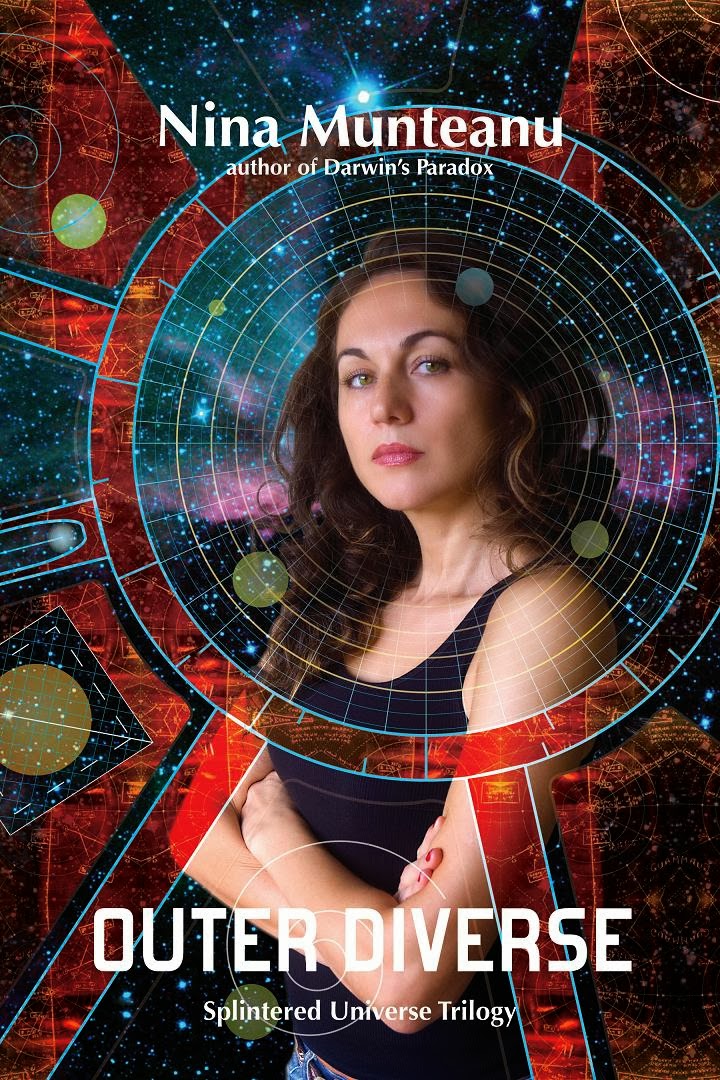
My trilogy The Splintered Universe follows detective
Rhea Hawke on her ill-fated quest for justice in a religious massacre. A major
part of the plot revolves around her turbulent relationship with a strange man—directly
related to her racist attitude. While the relationship is a critical element in
Rhea’s life journey, I would certainly not call the book a romance. Yet, without the romance, the story would
fall apart. Without the science fiction elements (e.g., world-building, aliens,
space travel, etc.), the story would also fall apart. Both are needed to make
this trilogy what it is.
Science fiction as
a genre is certainly evolving. It’s interesting to note that at no other time
are there more women interested in the genre, either reading it or writing it.
Women offer a different perspective on story, idea and vision of our world and
our future. It is an important perspective and one that relates very
importantly to consequence through relationship (the purview of science
fiction). Perhaps, we are experiencing the emergence of a new era; and some of
us are left struggling at the doorstep.

Nina Munteanu is an
ecologist and internationally published author of novels, short stories and
essays. She coaches writers and teaches writing at George Brown College and the
University of Toronto. For more about Nina’s coaching & workshops visit www.ninamunteanu.me. Visit www.ninamunteanu.ca for more about her writing.


