Showing posts with label nature. Show all posts

Wednesday, October 25, 2023

Nature’s Elegance: When Dying is Beautiful…


It started with my need for change. My need to discover. To witness beauty. That meant going outside. And I knew exactly where to go. 


I made a lunch and took some snacks, saddled myself in Benny (my trusted VW steed) and drove west. 


It was late October and the cold winds hadn’t yet cajoled the colourful leaves off the maples, aspens, birches and oaks. I knew I would witness something remarkable. I was in the north temperate zone of Canada, after all, and this was the height of autumn magic…


Soon, I was driving along one of my favourite country roads, a gently rolling barely paved road through forest and farmland that rose and fell over drumlins and eskers with views that make you sigh. A vibrant carpet of orange-crimson forest and copper-hued fields covered the undulating hills in a patchwork of colour.


I stopped frequently and stepped out into the light rain to take photographs. The air was fresh and clean against my skin as I breathed in the scent of wet vegetation and loam. A light mist washed the distant hills in muted shades of a watercolour painting. The nearby forests were anything but muted. I drove past flaming thickets of red-purple dogwoods and sumacs. Benny took me beneath neon canopies: the brilliant orange and deep reds of sugar and red maples, the lemon yellows and bronzes of aspens, oaks and beeches.


The flaming colours signify approaching death for the leaf. The deeper the colour, the closer to the end. 


With less light in fall, the green sugar-making pigment, chlorophyll, starts to break down. Other pigments, previously masked by the chlorophyll are revealed: the red-purples of anthocyaninand the oranges and yellows of carotenoids.As chlorophyll degrades, light striking the leaf may cause injury to its biochemical machinery, particularly the parts that regulate nutrient movement. So, these other pigments help to create a physical light shield and help the leaves efficiently move their nutrients into the twigs for the tree to use later.  


As the temperature plummets, the trees build a protective seal between the leaves and their branches, taking in as many nutrients as possible from the sugar-building leaves. Once the leaves are cut off from the fluid in the branches, they separate and drop to the ground, helped by the winds. Even in death, the leaves continue to contribute. On the ground, the fallen leaves decompose and restock the soil with nutrients; they also contribute to the spongy humus layer of the forest floor that absorbs and holds rainfall. Fallen leaves are also food for soil organisms, whose actions in turn keep the forest functional.


As I wove through the deep colours of autumn, I felt humbled by this naked beauty, so simply shown. So ingenuously revealed. How elegantly yet guileless nature went through its stages of individual dying to ensure renewal and growth for the whole.  


I returned home, invigorated and humbled by nature’s transient show. 


Within weeks, the bright leaves would fall, leaving the trees bare and gray and the ground a thick slippery carpet of brownish gray-black rot. Beauty enfolded, dissected and integrated. Insects, fungi, and bacteria would deliver what the leaves used to be and create something else, a gift to the living forest.


Is that not what death is? The end of something to ensure the beginning of something else?


Nina Munteanu is a Canadian ecologist / limnologist and novelist. She is co-editor of Europa SF and currently teaches writing courses at George Brown College and the University of Toronto. Visit www.ninamunteanu.ca for the latest on her books. Nina’s bilingual “La natura dell’acqua / The Way of Water” was published by Mincione Edizioni in Rome. Her non-fiction book “Water Is…” by Pixl Press(Vancouver) was selected by Margaret Atwood in the New York Times ‘Year in Reading’ and was chosen as the 2017 Summer Read by Water Canada. Her novel “A Diary in the Age of Water” was released by Inanna Publications (Toronto) in June 2020.


Sunday, October 2, 2022

Now is The Age of Nature…


Age of Nature is a series of three films made by PBS and narrated by Uma Thurman about humanity’s relationship with nature and wildlife and how scientists and conservationists study ways to restore the planet. The series, beautifully narrated and filmed, shows how restoring nature might be our best tool to slow global warming. From Borneo to Antarctica, the resilience of the planet is helping us find solutions to cope and even mitigate climate change, providing hope for a more positive future. The series consists of three episodes: AwakeningUnderstanding, and Changing:


In AWAKENINGyou will discover how a new awareness of nature is helping to restore mostly collapsed ecosystems; this included: restoring the cod fishery in Norway’s Lofoten Islands; the restoring the Chagres watershed in Panama; rehabilitating the collapsed ecosystem of Mozambique’s Gorongosa Park; and restoring the denuded Loess Plateau in China by planting a forest (and reducing the sediment in the Yellow River by 80%). This episode shows how innovative actions are being taken to repair human-made damage and restore reefs, rivers, animal populations and more.


“We are at a turning point in history,” says narrator Uma Thurman. “and moving in a new direction. How we live with nature now will determine our future. A new age is upon us, the age of nature.” This new awakening comes with a change in philosophy.


“Materialism has suggested that wealth is coming from things. But, in fact, wealth is coming from ecological function.”—John D. Liu, Ecosystem Ambassador, Commonland Foundation  


In UNDERSTANDING you will explore how a new understanding of nature is helping us find surprising ways to fix it. From the salmon runs and connection to forest health of the Pacific Northwest to restoring fireflies in China, and the reintroduction of wolves in Yellowstone—scientists, citizens and activists are restoring the environment, benefiting humans and animals alike.


“If humans get our acts together and start thinking about the whole ecosystem, we’re going to be recovering the whales and ultimately we’re going to be saving ourselves.”—Dr. Deborah Giles, Killer whale researcher, University of Washington 


In CHANGING you will discover why restoring nature might be our best tool to slow global warming. From Borneo to Antarctica, the resilience of the planet is helping us find solutions to cope and even mitigate climate change, providing hope for a more positive future. Bhutan’s negative carbon system is based on “decades of enlightened but courageous policies,” says Tshering Tobgay, former prime minister of Bhutan. By law they maintain over 60% forest cover to maintain a rich biodiversity and help balance climate as a carbon sink. Over 70% of Bhutanese live along river banks where they cultivate rice and other crops. “We’ve always had a strong association with water,” Tobgay adds. Something here ninahre.


“Ultimately, if we’re going to understand how to stop climate change, we need to understand our planet,” says Professor Tom Crowther, who leads a team of ecologists in categorizing forests and soils around the world from “on the ground information” to understand the carbon they contain and absorb. Crowther stresses that “the key is to restore these ecosystems in the right ecologically-minded way. That means we don’t plant trees in ecosystems that would naturally be grasslands. We also restore trees in a very biodiverse mixture; we don’t just want plantations, monoculture of the same species. We need all the different interacting species which help one another to grow and capture huge amounts of carbon…We absolutely need nature to survive on this planet. If humanity is going to have a chance, we’re going to have to restore ecosystems all across the globe…Biodiversity is the life support for our planet.”


The movie showcases three major ecosystems of significant carbon sequestration that need to be (and are in some cases) encouraged, nurtured and grown:


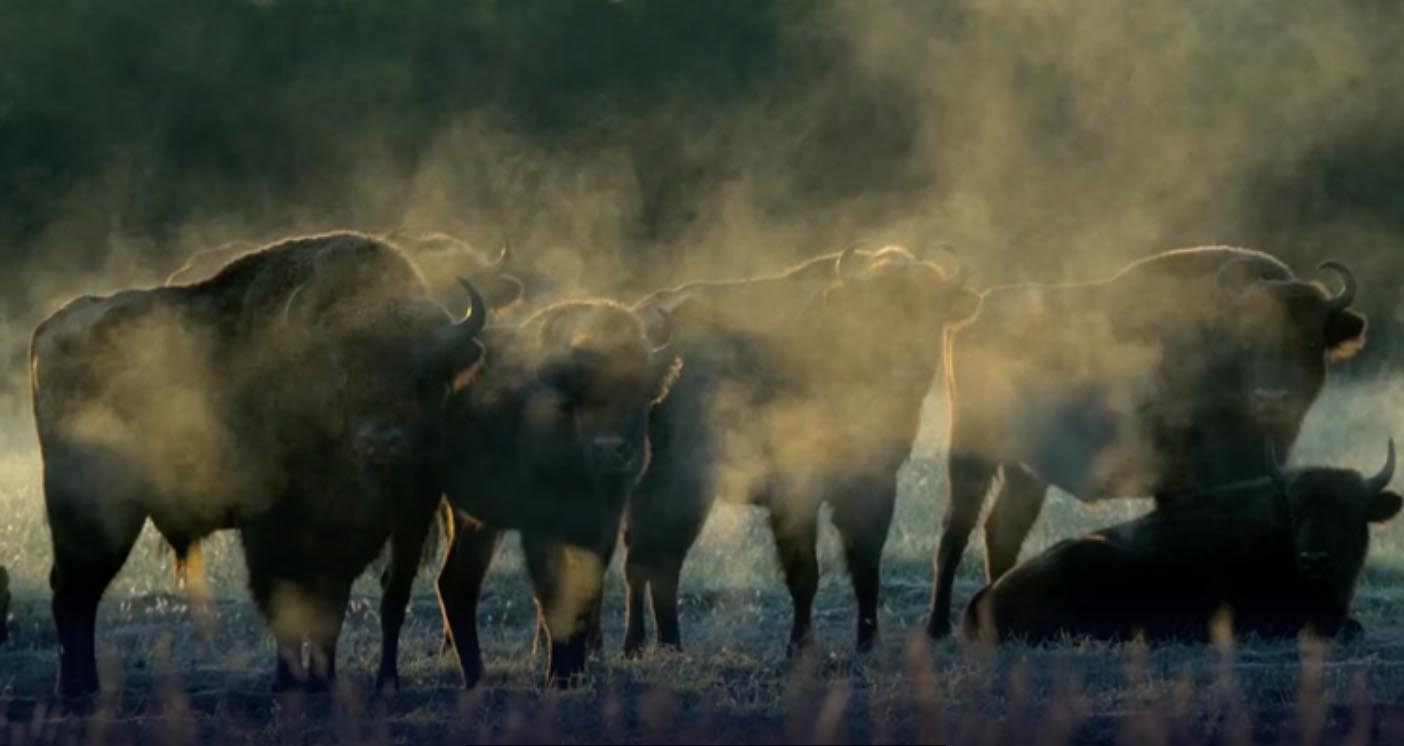
1.  Old growth forests of the world: Bialowieza in Poland is the oldest forest in Europe: 


Malgorzata Blicharska at Uppsala University reminds us of an ecological tenet: the higher the biodiversity of an ecosystem, the more stable and resilient it is. “The more complex the forest is, the more resilient it will be to different environmental pressures, which is really important now in relation to climate change.” A more complex ecosystem has a larger toolkit to draw from when confronted with change. “Even if one species with a particular function disappears because of climate change, there will be other species that take over this function.” This provides a natural buffer to change, helping it cope with disruption. “A natural forest is not a stable forest; it is changing all the time.” Adapting. The simpler the ecosystem, the less likely it will be equipped to adapt to imposed change; the more likely it will collapse with change. 


2,  Ocean phytoplankton, tidal marshes and seagrass meadows: Peter MacReadie, at Deakin University, studies seagrass meadows that store enormous amounts of carbon. They, along with tidal marshes and mangrove forests lock massive amounts of carbon; this is known as blue carbon. Mention what the mangroves do… “Blue carbon is definitely one of the new heros in the climate change mitigation scene.” They not only effectively sequester carbon, they protect coastlines, and they support half of the world’s fisheries.


MacReadie acknowledges the role apex predators in achieving balance in the ecosystem that might otherwise be destroyed by an over-abundance of herbivores. The apex predator keeps a balance not so much by eating prey but through what is called “fear ecology” and achieiving a healthy trophic cascade: the shark changes the behaviour of the next trophic level down, the turtle, that would otherwise over-graze the seagrass. “Through fear, they affect how much turtles breed, where they forage, where they move around,” ultimately creating a healthy balance of apex predators at the top, turtles in healthy balance and seagrass meadows thriving.”


3.  Peatlands: Taryono Darusman, director of research and development of the Katingan Project in Indonesia, tells us that, “globally, peatlands store around five hundred and fifty gigatons of carbon.” Covering only 3% of the land on Earth, peatlands absorb twice the amount of carbon in all the world’s forests—which are ten times the size. Peatland ecosystems also provide for a unique and highly biodiverse community. Peatlands form in wetlands and rainforests; many of these areas have been drained to create canals or for agriculture. The drying peatlands become susceptible to fire. The Borneo fires of 2015 released more carbon than all of North America’s industry of that same year.  


The last ten minutes of the film are truly heartwarming and encouraging as the film documents how awareness is growing and inspiring a grass roots movement, particularly with the brave efforts of youth around the world. People like young Dayak activist, Emmanuela Shinta (who worked with youth groups to replant a destroyed ecosystem in Kalimantan, Borneo), and eleven-year old Madison Edwards (who started a social media campaign to stop oil drilling off the shores of Belize). 


Eco-heroismis sprouting all over the planet in response to her need for balance. Showing us that every single individual can make a difference…  

Saturday, April 2, 2022

A Hidden Alvar Meadow Treasure


It was two years ago, on a crisp April morning—as I walked the naturalized trail through Peterborough—that magic found me. 


I was heading north and unsure where the trail would take me. My muse had brought me here to explore my new environment; I’d recently moved from the bustle of Toronto and felt the restlessness of discovery. The trail wound mostly through backyards and cleared parkland, lined with mixed woodland of locust, black walnut, maple and oak and clearings bordered by thickets of sumac and buckthorn. I caught glimpses of houses and backyards as I walked the trail, surrounded by a chorus of lively birdsong. Robins and cardinals. Goldfinches. Red-winged blackbirds brought fond memories of childhood with their signature conk-la-ree! Chickadees flitted across the trail and sang their chickadee-dee-dee. A group of grackles took over a lilac-buckhorn thicket, their chatter sounding like an overused squeaky clothes line.


The trail crossed a main road then a minor one and the backyards became harder to see as the shrubs and trees that lined the trail grew dense.


Then, at a set of rocks on the east side of the trail, the thicket opened to a grassy rise and I glimpsed a small path, leading up the rise. The path was more like a depression in the grass where repetitive footfalls had created a trail of sorts. Several mature buckthorns and willows dotted the crest of the rise. And beyond the crest … well, that was my question. What lay beyond it? From my current position I could only make out the possibility of forest in the distance. The main trail up to this point had been through forest scrub of sumac, dogwood, black locust and other shrubs dense enough to obscure what lay beyond them.


Drawn to what lay beyond the rise, I turned onto the path, boots crunching on a brittle layer of frost that had settled on the grass and leaf litter. It was a steep climb through slippery wet grass. When I crested the hill, I stopped and inhaled with wonder at the unexpected view below me. It was as though I’d walked through a portal. Gone was any sign of Peterborough suburbia; below me, stretching in all directions lay a vast natural meadow, with a maple-beech woodland rising to the east; striking white limbs of poplar trees marked the leading edge of the monochrome forest. 


The meadow that stretched before me was a gently rolling landscape of pale gold grasses and a chaos of strewn limestone rocks and gravel dotted by russet junipers and the gray-brown umber of dwarf hawthorn, buckthorn and sumac shrubs. In a lower depression in the centre of the meadow, a grove of young cedar trees added splashes of green to the gold-copper mosaic.  


I made my way down into the rock-strewn meadow and was immediately struck by the silence. As though a hush had settled there, a kind of sacred humility stayed me. I felt unexpectedly blessed. I walked with silent steps as if in a church, toward a grove of stunted sumacs and came suddenly face to face with two white-tailed deer. We were both startled. In that protracted moment when our gazes met, time paused and the world stopped. Then one deer sprang away, followed by the other, their shocking white behinds bobbing as they fled through the sumacs toward the forest.


As if by design, at that exact moment, it began to snow. Huge flakes fell lazily like confetti in a mild breeze. Then it came down in a thick passion. 


I felt the presence of magic.


Alvar Ecosystem


In the next two years, I returned many times to this magic place of barren beauty. My good friend and naturalist Merridy suggested that this meadow was likely an alvar, a distinct ecosystem that establishes on a limestone or dolostone plain with thin or no soil, and characterized by sparse grassland vegetation. This made sense to me, given the habitats I’d observed. Also called a pavement barrenof limestone pavementand a calcareous grassland, alvars are often flooded in the spring and affected by drought in midsummer. Because of this, alvars support a distinct prairie-like community of grass, lichen and mosses, as well as stunted trees and shrubs.


 The term ‘alvar’ originated in Sweden to describe the unique ecosystem of the Swedish island of Ã–land, with its unique exposed limestone slabs. Alvars are a rare ecosystem; they are found in a handful of places, including the eastern European Baltic region, the United Kingdom and Ireland. In North America, close to 75% of alvars are located in Ontario. Ecologists describe seven habitat types for alvar ecosystems in Ontario. These include: tall grassy meadows, tall forb-rich meadows, low grassy meadows, low forb-rich meadows, dry grassland, rock margin grassland, and bare rock flats. In my various wanderings through thisalvar meadow over the seasons, I recognized several of these habitats, from wet marshy lowland grass-forb meadow to dry tall grasslands and rock-strewn stretches of dry flatland.


Given the role of disturbance in the formation of alvars, I studied the lower ‘bowl’ of the meadow more closely for signs. An old structure may have once stood where semi-structured rock piles were arranged to form a square.  A patch of young cedars and birches—both flood-tolerant—surrounded it. I’d seen this same successional phenomenon in the Trent Nature Sanctuary, where it had been previously farmed. At the southern rising edge of the alvar stood a farmhouse, accessed by the little minor road I’d crossed earlier on the trail. I considered that this alvar was dominated by early sere plants, often the first to colonize a disturbed environment—lilac, hawthorn, buckthorn, sumac. Had there been a fire through here? Had someone tried to cultivate this site? It was surrounded by rural and residential development with a dedicated parkland (Trent Nature Sanctuary) of a drumlin maple-beech forest bordering it to the east. Attempts to cultivate parts of the nature sanctuary at one time are also evident.


This place remains a bit of a mystery and I am intrigued to solve it. Stay tuned…


Nina Munteanu is a Canadian ecologist / limnologist and novelist. She is co-editor of Europa SF and currently teaches writing courses at George Brown College and the University of Toronto. Visit www.ninamunteanu.ca for the latest on her books. Nina’s bilingual “La natura dell’acqua / The Way of Water” was published by Mincione Edizioni in Rome. Her non-fiction book “Water Is…” by Pixl Press(Vancouver) was selected by Margaret Atwood in the New York Times ‘Year in Reading’ and was chosen as the 2017 Summer Read by Water Canada. Her novel “A Diary in the Age of Water” was released by Inanna Publications (Toronto) in June 2020.

Monday, December 27, 2021

When Snow Turns Into Passion...


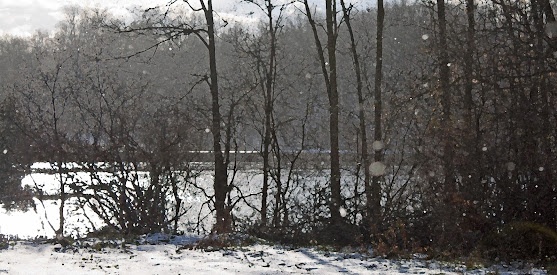
It started with a sudden hail then light snow followed by sunshine. But even as the sun shone, more snow fell. The stubborn river kept glinting in the sunlight. Huge flakes fluttered down and the river sparkled. Some trees lit up like torches behind the thick snowflakes. 


When I got to the marsh, the snow came down in a passion and the wind picked up. Huge flakes fell in a slant and covered the thin ice on the marsh edges. It covered the ducks, their backs full of snow, who ignored it all and just clucked and quacked and drifted close to me in curiosity. 


The clouds grew dark. Then the snow filled the sky and I could barely see the trees as I walked through the forest… 


By the time I made it to the path by the river, the snow was seized by a fierce wind and flew sideways.


Then, suddenly, like a hand on a shoulder, it all stopped. The wind and the snow. The sun emerged behind a dark scudding cloud and lit the water, now calm in the beauty after the storm.


Nina Munteanu
 is a Canadian ecologist / limnologist and novelist. She is co-editor of Europa SF and currently teaches writing courses at George Brown College and the University of Toronto. Visit www.ninamunteanu.ca for the latest on her books. Nina’s bilingual “La natura dell’acqua / The Way of Water” was published by Mincione Edizioni in Rome. Her non-fiction book “Water Is…” by Pixl Press(Vancouver) was selected by Margaret Atwood in the New York Times ‘Year in Reading’ and was chosen as the 2017 Summer Read by Water Canada. Her novel “A Diary in the Age of Water” was released by Inanna Publications (Toronto) in June 2020.


Sunday, June 21, 2020

Less Is More...


I wish you all joy and contemplation in this day. Because, today is Indigenous Day. EVERY day should be Indigenous Day…

All indigenous peoples incorporate Nature in their beliefs, philosophies and way of life. They conduct themselves with humility and the utmost respect for the natural world they are part of. They do not separate themselves from the sacredness of creation and the evolving world of matter and energy. All matter is living and has a soul, connected to the “oneness”. European settlers dismissed their wisdom as primitive and simple. How wrong the settlers were. How simple the settlers were. For this is the wisdom of quantum physics. Have we—their descendants—changed?


If COVID-19 has taught us anything I hope it is to live with less and rejoice in it. To be grateful for what we have. To take joy in acts of kindness to others. For to live with less is to give more and live lightly and sustainably for this dear planet of ours, our boon. Our sustenance. Our friend. Why is it, then, that we have ceased to converse with Her? We no longer communicate with Nature and Gaia. We’ve isolated ourselves with hubris and greed and the pursuit of wealth and power.  We’ve become unruly self-centred bullies who think somehow that Homo sapiens alone was ordained by God to rule this planet. But there is no ruling Her. Why do we still cling to the ancient human-centred philosophies that have created “the other”? Descartes expounded that no other life or being other than “man” had a soul. Or feelings, for that matter. This preposterous notion has carried on for over six hundred years into today’s abhorrent racism, the creation of homo sacer, creation of property, subjugation of women by men, patriarchy, androcracy, cruelty to animals, deforestation and so much more that ails us and the world. 


COVID-19 is but one iteration of a conversation Nature is trying to have with us. She is talking to us in words of climate change, storms, disease and pandemic. She is telling us something and we aren’t listening. Her message is clear: live in partnership. Live in humility and joy. Live the galanic life of cooperation, respect, and kindness to ALL THINGS in a world with no “others.” If we don’t start listening, we will find ourselves more than alone…


So, on this day, this Indigenous Day, I exhort you to go out into Nature. Hug a tree. Tell it that it is beautiful. Thank it for its shade. Feel its corky bark. Feel the miracle of creation sing through you. Touch a leaf, feel its supple texture and filigree of intricate markings and imagine the chloroplasts swimming inside, trapping energy from the sun. Smell the earth and breathe in the beauty of this day.


Nina Munteanu is a Canadian ecologist / limnologist and novelist. She is co-editor of Europa SF and currently teaches writing courses at George Brown College and the University of Toronto. Visit www.ninamunteanu.ca for the latest on her books. Nina’s bilingual “La natura dell’acqua / The Way of Water” was published by Mincione Edizioni in Rome. Her non-fiction book “Water Is…” by Pixl Press (Vancouver) was selected by Margaret Atwood in the New York Times ‘Year in Reading’ and was chosen as the 2017 Summer Read by Water Canada. Her novel “A Diary in the Age of Water” was released by Inanna Publications (Toronto) in June 2020.