|
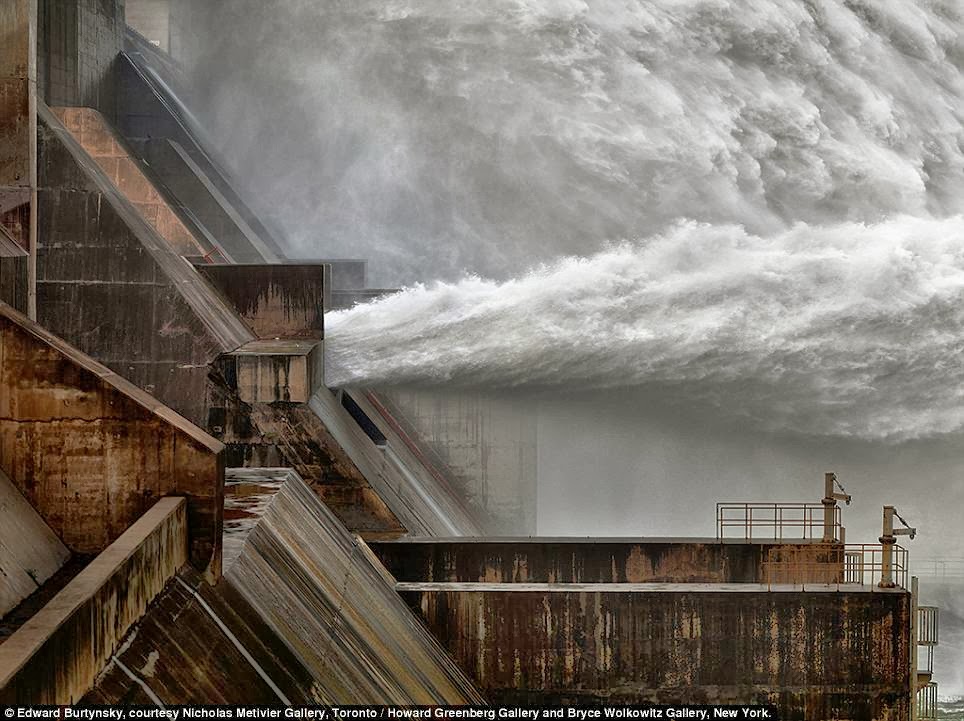
| Xiaolangdi Dam, China |
Water has been on my mind a lot
lately.
When I was five, I saw the Atlantic
Ocean for the first time. It changed the way I look at water; I recall being
fascinated by the sheer magnitude and power of it. How it created my world and
covered so much of it. When I was thirty-five, I toured Africa for the first
time. It changed the way I look at water. How without it I would not be alive. I
spent over twenty-five years teaching about it at university and researching it
and protecting it as a scientist and an environmental consultant. The mark that
water has left on me has been great.
Water is all around us. It’s in the
air we breathe. It covers 70 percent of the Earth. We are made of mostly water.
Here, in North America where water is generally plentiful, many of us tend to
take it for granted. Not renowned Canadian photographer Edward Burtynsky. In
fact, he’s made it part of his life’s work.
 |
| Edward Burtynsky |
Last night a friend took me to the
Toronto International Film Festival to watch a feature documentary on water by Burtynsky
and multiple-award winning filmmakers Jennifer Baichwal and Nick de Pencier. It
was called Watermark. It changed the way I look at water.
Shot in 5K ultra high-definition video,
Watermark soars with truly breathtaking aerial perspectives, wide expanses and
spectacular light. From its powerful opening scene of jetting spillway water
from the Xiaolangdi Dam on the Yellow River, China, to the turbulent waters of
the pristine rugged Stikine River valley of northern BC in the fall, Watermark features water in all its
humble glory: as a powerful terraforming element, and “magnificent force of
nature that we all too often take for granted—until it’s gone.”
 |
| rice terraces, China |
Burtynsky brought his eye for pattern,
texture and light into this visually stunning movie that spans ten countries
and twenty stories. Scenes flow from massive floating abalone farms off China’s
Fujian coast to the construction site of the biggest arch dam in the world—the
Xiluodu, six times the size of the Hoover. Images and scenes weave an evocative
story. There is the barren desert delta where the Colorado River no longer
reaches the ocean … The Panna Meena Stepwell of Rajasthan, India … The
polluting leather tanneries of Dhaka … The U.S. Open of Surfing in Huntington
Beach … the Kumbh Mela in Allahabad, where thirty million people gather for a
sacred bath in the Ganges … Scientists drill ice cores two kilometers deep into
the Greenland Ice Sheet … a lone water guardian walks the rice terraces of the
Western Yunnan Province in China.
Exploring pattern, filigree, light and
relief, Watermark juxtaposes contrasting imagery—to tell an epic story. Take
for instance, the two scenes in China, one of Xiluodu, the largest arch dam in
the world, and the other China’s traditional rice patties in the Western Yunnan
Province of China. They represent a new and an ancient perspective of the same
phenomenon: how to divert and use water.
 |
| Thjorsa River, Iceland |
“Water has a unique capacity to express
scale and detail simultaneously,” says filmmaker Jennifer Baichwal. “It can be
a meandering, pastoral brook and the trickle from the edge of an ice sheet, or
it can be a monumental force, like Niagara Falls and the Pacific Ocean.” Watermark is a visual essay that takes
the aerial grandness of a powerful scene and roots it in the intimacy of the
particular. This is a Burtynsky moniker: to show personal detail in the midst
of epic grandness; to tease out story from the chaos.
Many of the shots were taken from unique
angles and often from above, demonstrating context and providing a global link
that all of humanity can understand and resonate with. The documentary is more
contemplation and presentation, less rhetoric or polemic. Yet, lingering in the
shoals and quiet pools is a message.
There’s a reason why Burtynsky tells this
story (both as movie and book). He’s Canadian. “In Canada we are never far from
places where one can see how the land looks without our presence. Around the
globe, this has become a rare perspective,” says Burtynsky.
 |
| Stepwell, India |
In his article in the October 2013 issue
of The Walrus, Burtynsky explains why he started taking pictures of the earth’s
water, culminating in his book Burtynsky—Water
and the film Watermark: “The world’s
population was 2.8 billion when I was born. Not quite six decades later, 7.2
billion humans inhabit the planet. This fact runs through almost all my
photographs, but it became especially relevant when I started to think about
taking pictures of the earth’s water.”
“My photographs reflect the impact of
humanity, not its absence. They are pictures of our footprint, and the
diminishment of nature that results. They are distressed landscapes: images of
land, and now of water, that we have altered, or diverted, or transformed, or
used in this unprecedented period of population growth, agricultural expansion,
and industrialization. Documenting the point of impact between humankind and its
evolving environment has turned out to be a life’s work.”
“Canada borders the Great Lakes, which
contain 21 percent of the world’s fresh surface water,” writes Burtynsky. “The
other one to three million lakes in this country (depending on your definition
of “lake”) hold even more.” He contends that, “[Canada is] not an oil country.
We are a water country. The implications and the responsibilities are enormous…We
are custodians of over one-fifth of a resource that is utilitarian in the
broadest and most necessary sense: water enables everything to live. Without it,
there is wasteland—end of story.”
Watermark is a visual essay on this
planet’s most valuable and mysterious component. It is a quiet exhortation to
rethink our perspectives on an element that is both “common” and prized; an
element that, if it were not here, would mark the violent end of all life.
My upcoming book on water entitled Water Is… (due in Summer 2015 with Pixl Press) brings my
over twenty-years experience as an aquatic ecologist to explore what water
means to each of us. Here's an excerpt:
I’m a limnologist. I
study and help manage water in our environment; its flow, distribution, storage
and properties. I look at how water changes the landscape, carving out huge
valleys, forming deltas at river mouths, and polishing pebbles smooth on a
lakeshore. I investigate the effects of its contamination by toxins, organic
pollutants and disrespect. In its solid form, water has scraped out huge swaths
of land and formed some of our largest lakes, dropping moraine till in places
and melt water from ice blocks elsewhere. In its gaseous form, water controls
climate and weather.
Water is the most
common substance on Earth. Chemically, water is simply two atoms of hydrogen
joined to one of oxygen. Simple. Not so simple.For something so
“simply” made, water is pretty complex. Its unique properties make water possibly
the most important element of our existence and in ways most of us can’t
possibly imagine. Without water no life form could exist. Water is a universal
solvent. It transports all kinds of things from the sediment of the Nile River
to the oxygenated blood cells in your arteries. Water stores energy and heat.
It responds to and changes the properties of all manner of things.
One of humanity’s
greatest crimes is that we don’t treat water respectfully and with gratitude.
It’s free, after all. It’s everywhere, isn’t it? “Water is the ultimate
commons”, says author Barbara Kingsolver. That lack of respect and gratitude
engenders subtle abuse. And that abuse spills into self-abuse. All life is made
up of from 50 to 95 percent water with humans averaging 65 percent.We are water. What we
do to water we do to ourselves…
So,
what is water, really? And what does it mean to you and your loved ones?
Some
see water as a commodity like everything else that can make them rich; they
will claim it as their own to sell—yet it cannot be “owned” or kept.
Ultimately, water will do its job to energize you and give you life then quietly
take its leave; it will move mountains particle by particle with a subtle hand;
it will paint the world with beauty then return to its fold and rejoice; it
will travel through the universe and transform worlds; it will transcend time
and space to share and teach.
Water
is…
Look for Water Is… by Nina Munteanu, Pixl Press in Summer 2015 at Amazon, Barnes & Noble and a quality book store near you. For updates on the book and the subject of water, visit Nina's website The Meaning of Water.


 Nina Munteanu is an ecologist, limnologist and internationally published author of award-nominated speculative novels, short stories and non-fiction. She is co-editor of Europa SF and currently teaches writing courses at George Brown College and the University of Toronto. Visit