Tuesday, October 29, 2013

The Island, movie review

From its metaphoric title to its powerful end, Director Michael Bay’s The Island had me fully engaged. Told in the genuine style of great science fiction commentary by screenwriters Caspian Tredwell-Owen, Alex Kurtzman and Roberto Orci (in 2005), The Island reflects the escape-from dystopia films of the 1960s and 70s such as Fahrenheit 451, THX 1138, and Logan’s Run. This elegant story examines a full range of human foibles—consumerist greed, racism, fascism and isolationism—through a premise that is as frightening as it is possible.

In the year 2019, Lincoln Six Echo (Ewan McGregor) and Jordan Two Delta (Scarlett Johansson) live in an isolated community where behavior is governed by a set of strict rules. This includes the avoidance of too close contact. Everything is the same; residents all wear the same white uniform and carry out simple duties. They’ve been told that the outside world is too contaminated for human life with the exception of one island. Everyone lives for the weekly lottery, where the winner gets to leave the compound to live on the island.

It’s a simple and banal existence. We glimpse a scene of adults reading Dick and Jane out loud. When in the opening scene Lincoln Six Echo finds a shoe missing in his provided wardrobe, this becomes a major focus of his day (when greeted by a colleague with, “How are you doing?” he responds with, “I’m missing a shoe.”)
Lincoln can’t accept this mundane existence. In an interview with Dr. Merrick (Sean Bean), the scientist who runs the compound, Lincoln naively unleashes a tirade of items that frustrate him, like why everyone wears white, who determined tofu Tuesday, and then ends with: “I want to know answers and I wish there was more than just waiting to go to the island.” He also suffers from dreams about a life he doesn’t understand—they are, in fact, memories of his ‘sponsor’, the original man (Tom Lincoln) that he is a copy of.  When he discovers a moth and follows it, he stumbles into the hidden part of the compound. There he witnesses what really happens to “lottery winners”: they are killed and used for organ harvesting, surrogate motherhood, etc. for each one’s sponsor.
Lincoln is just an insurance policy. An ‘agnate’ according to Dr. Merrick, who describes them as in a “persistent vegetative state that never achieves consciousness” to clients, willing to pay millions of dollars for a second chance at life—and blithely unaware that ‘agnates’ are alive and fully formed with thoughts and feelings like them.
When Lincoln learns the truth, and knowing that Jordan just “won” the lottery, he convinces her to escape with him. Merrick hires Albert Laurent (Djimon Hounsou), a mercenary and former GIGN veteran, to find and dispatch them.

The Island received mixed reviews from critics, with a 40% “Rotten” rating, based on 185 reviews. Variety’s Justin Chang called the film an “exercise in sensory overkill.” Salon’s Stephanie Zacharek lamented that when the film got really interesting, Bay seemed to think he needed “to throw in a car crash or round of gunfire to keep our attention.” If these critics found fault with this elegant action-thriller, I hate to see what they make of 90% of the so-called SF movies out there today. Unlike them, The Island provides a refreshing meaningful face to action-adventure.

Sean Bean as Dr. Merrick
Roger Ebert suggested that The Island missed the opportunity “to do what the best science fiction does, and use the future as a way to critique the present.” Again, I disagree. The Island does what the best science fiction does well: it examines the nature of our humanity through the choices we make in adversity within a future world and premise that provides great opportunity for abuse.

The theme of this parable is carried evocatively by Steve Jablonsky’s score. Like a swelling tide it sweeps us on a journey to some distant shore. From the melodic strings and yearning chorus, the music builds to a powerful conclusion at the film’s end, when it lifts us to victory, resonating with our divine evolution. I was particularly struck by the timing of the strings and chorus with the appearance of Albert Laurent, walking among those he had just liberated. It is a pivotal and powerful moment that escalates into a resonating vibration of liberty and victory as his eyes meet briefly with Lincoln and Jordan, reunited, and he smiles—for the first time. A beautiful smile of inner joy. It is the smile of a man who has “come home” and is finally free.

Laurent’s subplot is particularly compelling and carries one of the principle elements of the film. In
Djimon Housou as Albert Laurent
some ways, Laurent represents you and me, caught up in our societal ‘duties’, seduced by self-serving entrapments only to awaken to a path of courageous compassion for all of humanity. Laurent’s journey from jaded mercenary to liberating hero begins when he notices Jordan’s skin branding and, recognizing a connection with her plight, helps her free the mass of ‘defective’ lottery winners about to be incinerated. We learn that his father had been killed as a rebel and Laurent was ‘branded’ as less than human. So, there he walks, brilliantly black among the white-clad ‘agnates’ who slide down the hill after emerging from the underground bunker in which they were incarcerated.

This motion picture is ultimately about finding dignity in the face of adversity and ridicule. It is about confronting the bully and gaining victory over one’s own barriers of fear and doubt toward compassion. It is about the power of love and connection with humanity. It is about retribution and finding one’s true path through the knowledge that we are all one.

I am you; you are me. You are the waves; I am the ocean. Know this and be free, be divine.” Sri Sathya Sai Baba


Nina Munteanu is an ecologist and internationally published author of novels, short stories and essays. She coaches writers and teaches writing at George Brown College and the University of Toronto. For more about Nina’s coaching & workshops visit www.ninamunteanu.me. Visit www.ninamunteanu.ca for more about her writing.


Friday, October 18, 2013

When Science Fiction Is Science Fiction


scene from Elysium
Paul Cook’s article “When Science Fiction Is Not Science Fiction” in Amazing Stories (Sept 4, 2013) and the prolific commentary it generated, got me thinking again about our evolving perceptions of what science fiction is, what it isn’t, what its role in literature is, and how it is generally perceived by both SF and non-SF readers. This article couldn’t have come at a better time either: This fall and winter I’ll be teaching my first semester at George Brown College and University of Toronto on how to write science fiction. And it’s aptly on the heels of a new award Amazing Stories has just created: the Excellence in SF Denialism Award (see September 8, 2013 post in Amazing Stories).

Cook proclaimed that he’s “too old to put up with indulgences by books claiming to be one thing, but are really something else.” He gave examples of various authors who, in his opinion, were really writing another genre (usually romance) and were calling it science fiction.  He called Gene Wolfe’s series The Book of the New Sun a Medieval/Arthurian fantasy—not science fiction. He described Lois McMaster Bujold as a closet romance writer and called her military SF Miles Vorkosigan series romance at its core—not science fiction. Is this a fair assessment? When does science fiction with romance turn into romance with SF elements?

Let’s start off with what science fiction isn’t.

Science Fiction Is Not Escapist Literature


Cook suggested that SF is an “escapist genre”. Good science fiction is, in fact, quite the opposite. I stress “good” science fiction. Of a surety, all genres contain escapist works. But for the sake of this argument, I speak of that which best represents the genre.

It is a profound mistake to interpret the genre of science fiction literally. Science Fiction is both “the great modern literature of metaphor and pre-eminently the modern literature not of physics but of metaphysics,” says Australian scholar and critic Peter Nicholls. Science fiction has been referred to as the literature of “idea”, of “the large”, and of “change & transformation”. How does science fiction achieve this great scope? It does so through metaphor.

Science Fiction is the Literature of Allegory & Metaphor

In an article in the June 2005 The Guardian entitled “Why We Need Science Fiction”, Margaret Atwood submits that science fiction explores the relationship of humanity to the universe. It is “an exploration that often takes us in the direction of religion and can meld easily with mythology,” says Atwood who cites the obvious religious allegories of Star Wars and The Matrix. Author Brian Ott reminds us that it is not what the aliens are but what they represent that matters. Good science fiction is allegory.

Literature in general has always served as a cultural reporter on themes important to humanity. The science fiction genre—and speculative fiction particularly—explores premise based on current scientific and technological paradigms. What if we kept doing this?…What if that went on unchecked?… What if we decided to end this?… These are conveyed through the various predictive visions from cautionary tales (e.g., Atwood’s Oryx and Crake) to dystopias (e.g., Huxley’s Brave New World). Where realist fiction makes commentary on our current society, science fiction takes that commentary into the realm of consequence by showing it to us in living colour. This is its power over contemporary fiction and why, I think, mainstream literary authors like Margaret Atwood have discovered and embraced this genre (her latest three books are all science fiction). Science fiction doesn’t just “tell us”; it can “show us”.

In science fiction, science provides the premise and fiction explores the answer. Themes like achieving forgiveness, love & compassion, overcoming fear, taking control of one’s fate & fulfilling one’s destiny, etc. are often played out through the encounter of—and often clash with—“the other.” The “other” may be aliens, peoples of a different culture, some new technology, a fantastical unknown entity, or a place with strange powers. In the end, the POV characters must overcome their own darkness, reflected in “the other” to ultimately prevail.

In Neill Blomkamp’s District 9 set aptly in an alternate present-day Johannesburg, in which visiting 
aliens have been incarcerated within filthy ghettos, the heroic journey of the ordinary human WIkus van de Merwe reflects the global journey of humanity in reaction to the “other”.

Blomkamp’s metaphors to our jaded history of prejudice and racism are clever and vary from the subtle to the obvious. While many viewers saw no further than the thrilling elements of the movie—alien visitation; kick-ass weapons and cool creatures getting blown up—District 9 conveyed a powerful allegory that asks unsettling questions about colonial powers. Critic Frederic Jameson reiterates, “Science Fiction is in its very nature a symbolic meditation on history itself.”

Science Fiction is Subversive Literature

Oscar Wilde once said: “Art is individualism, and individualism is a disturbing and disintegrating force. There lies its immense value. For what it seeks is to disturb monotony of type, slavery of custom, tyranny of habit, and the reduction of man to the level of a machine.” Susan Sontag said, “Real art makes us nervous.” For me, that is what science fiction does: it examines our world and presents us with new perspectives to ponder, and evolve from. Without darkness to contrast it, light cannot be recognized for its virtues, nor can it even be properly seen; darkness is the platform from which light emerges in all its glory. I’m not just talking about good and evil. Metaphorically, darkness represents anything within us that is repressed, that we’re ashamed of or uncomfortable with. It is the unknown—and the stuff of science fiction.

Science fiction illuminates our history and our very humanity. It does this by examining our interaction with “the other”, the unfamiliar. A new relationship. A stranger in town. A scientific discovery. A clash of cultures. An alien encounter. How do we react? Is it with fear? Wonder? Curiosity?


Good SF accurately takes the premise of real science and explores it to the realm of possibility and consequence. This genre, more than any other, gives us the opportunity to look at what may be, how we get there and what happens to us as a result. Think of the writings of Greg Bear, Robert J. Sawyer, Robert Wilson, Kay Kenyon, William Gibson, Robert Silverberg, Isaac Asimov, Stanislav Lem, and Ray Bradbury (to name some of my own favorites). The SF writer is both herald and conscience of science and humanity. We are commentators of the present and reporters of the future. Science fiction is subversive literature.

Science Fiction is the Literature of Change & Transformation

Science fiction is a genre of global examination and evolution. It explores humanity’s own identity, our values and our evolution by showing how we react to change and the unknown. Science fiction postulates and extrapolates. It takes a plausible premise (idea) and runs with it. In most science fiction something significant happens, is discovered or is revealed that is science-based and has profound effects on the world—See John Wyndham’s The Chrysalids, Isaac Asimov’s I, Robot, Ray Bradbury’s Martian’s Chronicles, Robert J. Sawyer’s Calculating God, Nina Munteanu’s Darwin’s Paradox (apologies–I just had to throw that one in!). The events, actions or discoveries throw the main protagonist and his/her world off balance into a full-tilt journey of self-discovery (the classic hero’s journey). Science fiction is the transformative literature of change.

Science Fiction is the Literature of Relationship

All great literature distills its art form through the exploration of relationship: our relationship with technology, with science, nature, God, our children, each other, our history, our destiny, etc. etc. etc. Story happens when character intersects with issue (plot and theme). Without characters and without a world for them to interact with in ways that illuminate some thematic issue, there would be no story and no one to empathize with.  

What better art form than the “love story” to discover our humanity. It is through love—in all its facets—that we find passion, courage, direction and meaning in life. And there are as many different forms of love as there are love stories: romantic love, platonic love, altruistic love, heroic love, maternal love, filial love, charitable love, divine love, unconditional love, and so on.

The greatest love stories also tell of hardship overcome, lessons learned, and barriers surmounted. The Great Gatsby by F. Scott Fitzgerald is, in fact, a cautionary tale about the American Dream. It explores themes of decadence, idealism, and the social barriers between economic strata through the ill-fated love between the self-made and quixotic Jay Gatsby and the ultra-rich and spoiled Daisy Buchanan. Thomas Hardy’s Tess of the d’Urbervilles explored similar themes of class prejudice and privilege through the tragic love story of Tess and Angel Clare. I could list many stories that explore major social and cultural issues through love. Think of them: Gone with the Wind by Margaret Mitchel; Doctor Zhivago by Boris Pasternak; Vanity Fair by William Makepeace Thackeray; The English Patient by Michael Ondaatje; Wuthering Heights by Emily Bronte; The French Lieutenant’s Woman by John Fowles…just to name a few. Most of us wouldn’t think to call these love stories at first; yet, that’s what they are—told against a strong setting of historical and social commentary.

Strong elements of love, romance and relationship underlie many science fiction stories. And to revisit Lois McMaster Bujold, the Vorkosigan series interlaces relationship with a tapestry of political intrigue between cultures and explores class privilege, disabilities, and the evolution of cultural practices.


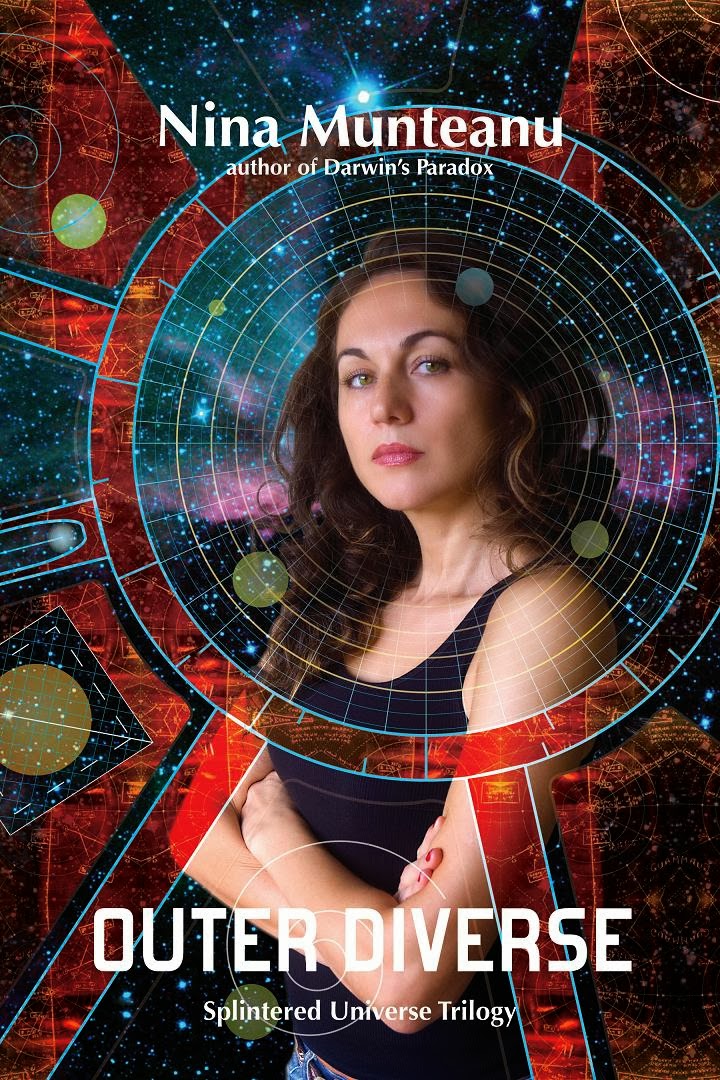
My trilogy The Splintered Universe follows detective Rhea Hawke on her ill-fated quest for justice in a religious massacre. A major part of the plot revolves around her turbulent relationship with a strange man—directly related to her racist attitude. While the relationship is a critical element in Rhea’s life journey, I would certainly not call the book a romance.  Yet, without the romance, the story would fall apart. Without the science fiction elements (e.g., world-building, aliens, space travel, etc.), the story would also fall apart. Both are needed to make this trilogy what it is.

Science fiction as a genre is certainly evolving. It’s interesting to note that at no other time are there more women interested in the genre, either reading it or writing it. Women offer a different perspective on story, idea and vision of our world and our future. It is an important perspective and one that relates very importantly to consequence through relationship (the purview of science fiction). Perhaps, we are experiencing the emergence of a new era; and some of us are left struggling at the doorstep.


Nina Munteanu is an ecologist and internationally published author of novels, short stories and essays. She coaches writers and teaches writing at George Brown College and the University of Toronto. For more about Nina’s coaching & workshops visit www.ninamunteanu.me. Visit www.ninamunteanu.ca for more about her writing.

Thursday, October 3, 2013

Watermark: the Meaning of Water...


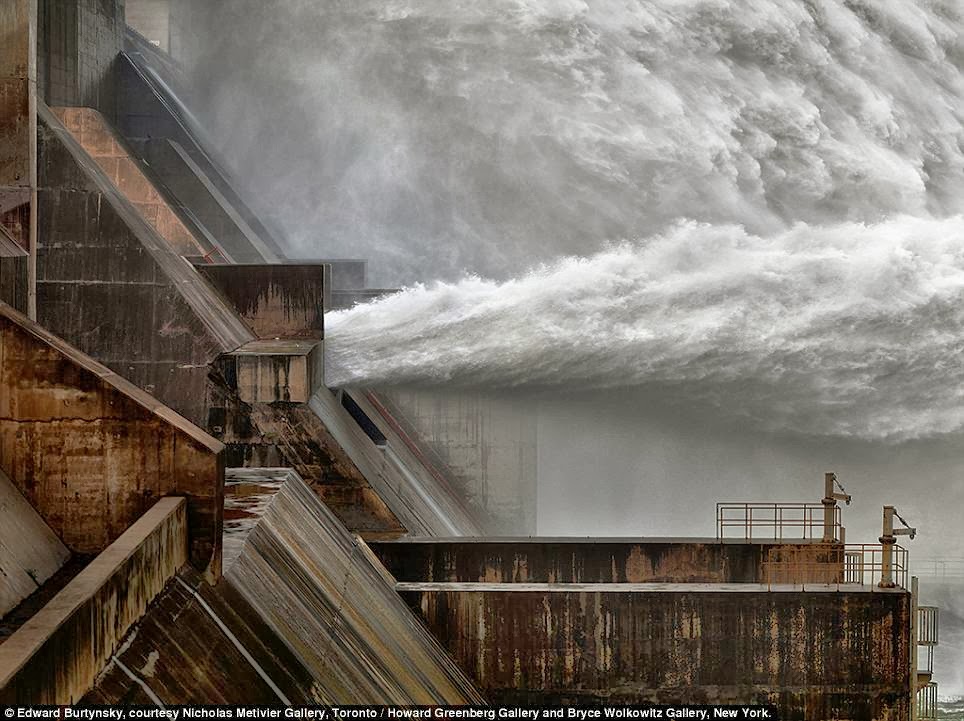
Xiaolangdi Dam, China

Water has been on my mind a lot lately.
When I was five, I saw the Atlantic Ocean for the first time. It changed the way I look at water; I recall being fascinated by the sheer magnitude and power of it. How it created my world and covered so much of it. When I was thirty-five, I toured Africa for the first time. It changed the way I look at water. How without it I would not be alive. I spent over twenty-five years teaching about it at university and researching it and protecting it as a scientist and an environmental consultant. The mark that water has left on me has been great.
Water is all around us. It’s in the air we breathe. It covers 70 percent of the Earth. We are made of mostly water. Here, in North America where water is generally plentiful, many of us tend to take it for granted. Not renowned Canadian photographer Edward Burtynsky. In fact, he’s made it part of his life’s work.
Edward Burtynsky
Last night a friend took me to the Toronto International Film Festival to watch a feature documentary on water by Burtynsky and multiple-award winning filmmakers Jennifer Baichwal and Nick de Pencier. It was called Watermark. It changed the way I look at water.
Shot in 5K ultra high-definition video, Watermark soars with truly breathtaking aerial perspectives, wide expanses and spectacular light. From its powerful opening scene of jetting spillway water from the Xiaolangdi Dam on the Yellow River, China, to the turbulent waters of the pristine rugged Stikine River valley of northern BC in the fall, Watermark features water in all its humble glory: as a powerful terraforming element, and “magnificent force of nature that we all too often take for granted—until it’s gone.”
rice terraces, China
Burtynsky brought his eye for pattern, texture and light into this visually stunning movie that spans ten countries and twenty stories. Scenes flow from massive floating abalone farms off China’s Fujian coast to the construction site of the biggest arch dam in the world—the Xiluodu, six times the size of the Hoover. Images and scenes weave an evocative story. There is the barren desert delta where the Colorado River no longer reaches the ocean … The Panna Meena Stepwell of Rajasthan, India … The polluting leather tanneries of Dhaka … The U.S. Open of Surfing in Huntington Beach … the Kumbh Mela in Allahabad, where thirty million people gather for a sacred bath in the Ganges … Scientists drill ice cores two kilometers deep into the Greenland Ice Sheet … a lone water guardian walks the rice terraces of the Western Yunnan Province in China.
Exploring pattern, filigree, light and relief, Watermark juxtaposes contrasting imagery—to tell an epic story. Take for instance, the two scenes in China, one of Xiluodu, the largest arch dam in the world, and the other China’s traditional rice patties in the Western Yunnan Province of China. They represent a new and an ancient perspective of the same phenomenon: how to divert and use water.
Thjorsa River, Iceland
“Water has a unique capacity to express scale and detail simultaneously,” says filmmaker Jennifer Baichwal. “It can be a meandering, pastoral brook and the trickle from the edge of an ice sheet, or it can be a monumental force, like Niagara Falls and the Pacific Ocean.” Watermark is a visual essay that takes the aerial grandness of a powerful scene and roots it in the intimacy of the particular. This is a Burtynsky moniker: to show personal detail in the midst of epic grandness; to tease out story from the chaos.
Many of the shots were taken from unique angles and often from above, demonstrating context and providing a global link that all of humanity can understand and resonate with. The documentary is more contemplation and presentation, less rhetoric or polemic. Yet, lingering in the shoals and quiet pools is a message. 

There’s a reason why Burtynsky tells this story (both as movie and book). He’s Canadian. “In Canada we are never far from places where one can see how the land looks without our presence. Around the globe, this has become a rare perspective,” says Burtynsky.
Stepwell, India
In his article in the October 2013 issue of The Walrus, Burtynsky explains why he started taking pictures of the earth’s water, culminating in his book Burtynsky—Water and the film Watermark: “The world’s population was 2.8 billion when I was born. Not quite six decades later, 7.2 billion humans inhabit the planet. This fact runs through almost all my photographs, but it became especially relevant when I started to think about taking pictures of the earth’s water.”
“My photographs reflect the impact of humanity, not its absence. They are pictures of our footprint, and the diminishment of nature that results. They are distressed landscapes: images of land, and now of water, that we have altered, or diverted, or transformed, or used in this unprecedented period of population growth, agricultural expansion, and industrialization. Documenting the point of impact between humankind and its evolving environment has turned out to be a life’s work.”
“Canada borders the Great Lakes, which contain 21 percent of the world’s fresh surface water,” writes Burtynsky. “The other one to three million lakes in this country (depending on your definition of “lake”) hold even more.” He contends that, “[Canada is] not an oil country. We are a water country. The implications and the responsibilities are enormous…We are custodians of over one-fifth of a resource that is utilitarian in the broadest and most necessary sense: water enables everything to live. Without it, there is wasteland—end of story.”
Watermark is a visual essay on this planet’s most valuable and mysterious component. It is a quiet exhortation to rethink our perspectives on an element that is both “common” and prized; an element that, if it were not here, would mark the violent end of all life.
My upcoming book on water entitled Water Is… (due in Summer 2015 with Pixl Press) brings my over twenty-years experience as an aquatic ecologist to explore what water means to each of us. Here's an excerpt:
I’m a limnologist. I study and help manage water in our environment; its flow, distribution, storage and properties. I look at how water changes the landscape, carving out huge valleys, forming deltas at river mouths, and polishing pebbles smooth on a lakeshore. I investigate the effects of its contamination by toxins, organic pollutants and disrespect. In its solid form, water has scraped out huge swaths of land and formed some of our largest lakes, dropping moraine till in places and melt water from ice blocks elsewhere. In its gaseous form, water controls climate and weather. 
Water is the most common substance on Earth. Chemically, water is simply two atoms of hydrogen joined to one of oxygen. Simple. Not so simple.For something so “simply” made, water is pretty complex. Its unique properties make water possibly the most important element of our existence and in ways most of us can’t possibly imagine. Without water no life form could exist. Water is a universal solvent. It transports all kinds of things from the sediment of the Nile River to the oxygenated blood cells in your arteries. Water stores energy and heat. It responds to and changes the properties of all manner of things. 
One of humanity’s greatest crimes is that we don’t treat water respectfully and with gratitude. It’s free, after all. It’s everywhere, isn’t it? “Water is the ultimate commons”, says author Barbara Kingsolver. That lack of respect and gratitude engenders subtle abuse. And that abuse spills into self-abuse. All life is made up of from 50 to 95 percent water with humans averaging 65 percent.We are water. What we do to water we do to ourselves… 
So, what is water, really? And what does it mean to you and your loved ones?
Some see water as a commodity like everything else that can make them rich; they will claim it as their own to sell—yet it cannot be “owned” or kept. Ultimately, water will do its job to energize you and give you life then quietly take its leave; it will move mountains particle by particle with a subtle hand; it will paint the world with beauty then return to its fold and rejoice; it will travel through the universe and transform worlds; it will transcend time and space to share and teach. 
Water is…

Look for Water Is… by Nina Munteanu, Pixl Press in Summer 2015 at Amazon, Barnes & Noble and a quality book store near you. For updates on the book and the subject of water, visit Nina's website The Meaning of Water.