Showing posts with label A hero's journey. Show all posts

Wednesday, February 22, 2012

Finding the Courage to Write ... and Publish

Are you afraid to write, to answer the call of your creative urges? Good. If you’re not scared, you’re not writing — Ralph Keyes


“Being creative means giving yourself the freedom to be who you really are,” says Nancy Slonim Aronie, author of Writing from the Heart: Tapping the Power of Your Inner Voice.

But that takes courage. A lot of courage.

Ralph Keyes, author of The Courage to Write, admits that “what makes writing so scary is the perpetual vulnerability of the writer. It’s not the writing as such that provokes our fear so much as other people’s reaction to our writing.” In fact, adds Keyes, “the most common disguise is fear of them, their opinion of us, when it’s actually our own opinion of ourselves that we’re worried about.” Keyes suggests that ultimately “mastering techniques [of style and craft] will do far less to improve writing than finding the will, the nerve, the guts to put on paper what you really want to say.”

I was recently in Montreal at a writers’ convention, launching my new book Outer Diverse along with several other authors and I recall one admitting to feeling terror when her first short story — whose main antagonist was based on her mother — was accepted by a magazine. Her first thought was: what have I done?

Says Keyes: “Any writing lays the writer open to judgment about the quality of his work and thought. The closer he gets to painful personal truths, the more fear mounts — not just about what he might reveal, but about what he might discover should he venture too deeply inside. But to write well, that’s exactly where we must venture.”

So, why do it, then? Why bother? Is it worth it to make yourself totally vulnerable to the possible censure and ridicule of your peers, friends, and relatives? To serve up your heart on a platter to just have them “drag it around” as Stevie Nicks would say…

Welcome to the threshold of your career as a writer. This is where many aspiring writers stop: in abject fear, not of failure but of “success”. The only difference between those that don’t and those that do, is that the former come to terms with their fears, in fact learn to use them as a barometer to what is important.

How do you get past the fear of being “exposed”, past the anticipated disappointment of peers, past the terror of success?

The answer is passion.

If you are writing about something you are passionate about, you will find the courage to see it through. Says Keyes, “the best writing flows less from acquired skill than conviction expressed with courage. By this I don’t mean moral convictions, but the sense that what one has to say is something others need to know.”

This is ultimately what drives a writer to not just write but to publish: the need to share one’s story, over and over again. To prevail, persist, and ultimately succeed, a writer must have conviction and believe in his or her writing. You must believe that you have something to say that others want to read. Ask yourself why you are a writer. Your answer might surprise you.

Every writer is an artist. And every artist is a cultural reporter, whose business is to report the truth and sometimes hold a culture accountable.

“Real art,” says Susan Sontag, “makes us nervous.”

The first step is to acknowledge your passion and own it. Flaunt it, even. Find your conviction, define what matters and explore it to the fullest. You will find that such an acknowledgement will give you the strength and fortitude to persist and persevere, particularly in the face of those fears. Use the fears to guide you into that journey of personal truths. Frederick Busch described it this way: “You go to dark places … to steal the trophy and get out.” You are the hero.

Every writer, like his or her protagonist, is on a Hero’s Journey. Like the Hero of our epic, we too must acknowledge the call, pass the threshold guardian, maneuver the abyss and face the beast before we can return “home” with our prize.

“If you long to excel as a writer,” says Finke, “treasure the passion that is unique within yourself. Take the irreplaceable elements of your life and craft them into your own personal contribution to the world.” And worry about the rest later.


Nina Munteanu is an ecologist and internationally published author of novels, short stories and essays. She coaches writers and teaches writing at George Brown College and the University of Toronto. For more about Nina’s coaching & workshops visit www.ninamunteanu.me. Visit www.ninamunteanu.ca for more about her writing.

Wednesday, November 9, 2011

A Hero’s Journey: Part 2, Heroes and Other Archetypes

The world of fairy tales and myth is peopled with recurring character types and relationships. Heroes on a quest, heralds and wise old men or women who provide them with “gifts” or motive, shady fellow-travelers—threshold guardians—who “block” the quest, tricksters who confuse things and evil villains who simply want to destroy our hero and her quest.

Jung adopted the term archetypes, which means ancient patterns of personality shared by humanity, to describe these as a collective unconscious. An archetype models a personality or behavior; a mother-figure is an archetype. This is what makes archetypes, or symbols, so important to the storyteller. Archetypes are found in nearly all forms of literature, with their motifs mostly rooted in folklore.

Assigning an archetype to a character lets the writer clarify that character’s role in the story. Archetypes are an important tool in the universal language of storytelling, just as myth serves the overall purpose of supplying “the symbols that carry the human spirit forward.” (Joseph Campbell). Joseph Campbell went so far as to describe the archetype as something that is expressed biologically and is wired into every human being.

Christopher Vogler, author of The Writer’s Journey, lists the seven most useful archetypes for the writer.

The Hero

The hero sacrifices his own needs on behalf of others. He provides a character for us to identify with and is usually the principal POV character in a story, with qualities most readers can (or want to) identify with. The hero “transforms” through her journey as she encounters other archetypes on her journey, whether it is a physical journey or a psychological journey toward “home” (salvation or redemption) through sacrifice. The true mark of the hero, says Vogler, is in the act of sacrifice: “the hero’s willingness to give up something of value, perhaps even her own life, on behalf of an ideal or a group,” and ultimately for the greater good.

Heroes may be willing or unwilling. Anti-heroes are notably flawed characters that must grow significantly to achieve the status of true hero. Often the anti-hero starts off more like a villain, like Tom Cruise’s character in Rainman. The wounded anti-hero may be a “heroic knight in tarnished armor, a loner who has rejected society or been rejected by it,” says Vogler: Aragorn in Lord of the Rings. The catalyst hero shows less of a character arc, but precipitates significant change or transformation in other protagonists. A good example is David Adams, in Ben Bova’s Colony.

The Mentor

The mentor often possesses divine wisdom and has faith in the hero. He often gives the hero a “gift”, which is usually something important for the quest; either a weapon to destroy a “monster” or a “talisman” to enlighten the hero. A good example is in Star Wars, when Luke’s mentor, Obi Wan, provides him with his father’s lightsaber (Luke’s magic talisman).

The Herald

Heralds announce the coming of significant change, whether the hero likes it or not (and usually they don’t). They deliver the call to adventure. The herald is a catalyst that enters the story and makes it impossible for the hero to remain in status quo. Existing in the form of a person, an event, or just information, they shift the hero’s balance and change her world.

In Star Wars, Ben Kenobi issues the call when he invites Luke to join him on his mission to Alderaan. The herald also provides the hero with motivation. In Romancing the Stone, the herald for Joan Wilder comes to her as a treasure map in the mail, and a distressed phone call from her sister.

The Threshold Guardian

This archetype guards the threshold of “Separation from the Ordinary World” on the hero’s quest to achieve his destiny. Threshold guardians spice up the story by providing obstacles the hero must overcome. Threshold guardians are usually not the main antagonist. In the Harry Potter series, this role is fulfilled by Malfoy, Snape or Filch, even. They help round-out the hero’s journey and develop his character arc. The threshold guardian can be a “friend” who doesn’t believe in the hero or her quest. Ultimately, this is the role of the threshold guardian: to test the hero’s resolve in her quest.

The Shape shifter

The shape shifter adds dramatic tension to the story and provides the hero with a puzzle to solve. They can seem one thing and in fact be another. They bring doubt and suspense to the story and test the hero’s abilities to discern her path. Yoda in Star Wars is a bit of a shape shifter, initially masking his ancient wisdom with a foolish childlike appearance when Luke first encounters him.

The Shadow

The monster under the bed, repressed feelings, deep trauma, a festering guilt: these all possess the dark energy of the shadow. This is the dark force of the unexpressed, unrealized, rejected, feared aspects of the hero and represented by the main antagonist or villain.

Voldermort in the Harry Potter series; Darth Vader in Star Wars. These are shadows and worthy opponents for the hero, bringing out the best in her and usually demanding the ultimate in self-sacrifice (the hero’s destiny).The shadow force, if internalized by the hero, may serve as a threshold guardian, to overcome; ultimately challenging the hero to overcome her greatest weakness and prevail.

The Trickster

Practically every Shakespearian play contains a jester or fool, who not only serves as comic relief but as commentator. This is because tricksters are usually witty and clever, even when ridiculous. The comedy of most successful comedians touches upon the pulse of a culture by offering commentary that is truism (often in the form of entertaining sarcasm).


Recommended Reading:

Cameron, Julia. 1992. The Artist’s Way: a Spiritual Path to Higher Creativity. Penguin Putnam. 222pp.

Campbell, Joseph. 1970. The Hero with a Thousand Faces. World Publishing Co. New York.

Henderson, Mary. 1997. Star Wars: The Magic of Myth. Bantam Spectra. New York. 214pp.

Vogler, Christopher. 1998. The Writer’s Journey: Mythic Structure for Writers. 2nd Edition. Michael Wiese Productions, Studio City, California. 326pp.


Nina Munteanu is an ecologist and internationally published author of novels, short stories and essays. She coaches writers and teaches writing at George Brown College and the University of Toronto. For more about Nina’s coaching & workshops visit www.ninamunteanu.me. Visit www.ninamunteanu.ca for more about her writing.

Wednesday, November 2, 2011

The Hero’s Journey: Part One, the Hero & the Journey

All stories consist of … common structural elements found universally in myths, fairy tales, dreams, and movies. They are known collectively as The Hero’s Journey — Christopher Vogler, “The Writer’s Journey: Mythic Structure for Writers”

“The Hero’s Journey” myth follows the three-act structure of the ancient Greek play, handed down to us thousands of years ago. Drawn from the depth psychology of Swiss psychologist Carl Jung and the scholar and mythologist Joseph Campbell, author of The Hero with a Thousand Faces, it duplicates the steps of the “Rite of Passage” and is a process of self-discovery and self-integration.

The Power of Myth & Archetype

Campbell recognized that myths weren’t just abstract theories or quaint ancient beliefs but practical models for understanding how to live. Ultimately, the Hero’s Journey is the soul’s search for “home”. It is a journey of transformation we all take, in some form. This is why the Hero’s Journey model for writing is so relevant and why it appeals to all readers.

Jung proposed that symbols appear to us when there is a need to express what thought cannot think or what is only divined or felt. Jung discovered reoccurring symbols among differing peoples and cultures, unaffected by time and space. He described these shared symbols as archetypes: irrepressible, unconscious, pre-existing forms of the psyche. Joseph Campbell suggested that these mythic images lay at the depth of the unconscious where humans are no longer distinct individuals, where our minds widen and merge into the mind of humankind. Where we are all the same.

The Hero’s Journey in Storytelling

Compelling stories resonate with the universal truths of metaphor within the consciousness of humanity. According to Joseph Campbell this involves an open mind and a certain amount of humility; and giving oneself to the story...not unlike the hero who gives her life to something larger than herself: "Anyone writing a creative work knows that you yield yourself, and the book talks to you and builds itself....you become the carrier of something that is given to you from … the Muses or God. This is no fancy, it is a fact. Since the inspiration comes from the unconscious, and since the unconscious minds of the people of any single small society have much in common, what the shaman or seer [or artist] brings forth is something that is waiting to be brought forth in everyone.” I call this tapping into the universal truth where metaphor lives. A story comes alive when these two resonate.

Vogler suggested that using the principles of myth, helps “create a masterful story that is dramatic, entertaining, and psychologically true.”

The Hero and the Journey

Heroes are agents of change on a quest. The hero is the ultimate altruist, sacrificing her life for the greater good. She is warrior and lover who slays the dragon of the status quo, so to speak. She enacts the ultimate in sacrifice in her quest to change the world (and/or herself). The hero’s task has always been to bring new life to an ailing culture, says Carol S. Pearson, author of The Hero Within. Julia Cameron reiterates this in her book, The Artist’s Way, when she describes the concept of art as a healing journey (not just for the individual but for a culture). This is because the writer/artist changes society by changing themselves.

Campbell describes a 12-step journey of the hero within 3-acts and influenced by five major archetypes (herald, mentor, threshold guardian, trickster, shadow and shapeshifter). Our hero starts her journey in Act 1 — in the Ordinary World — and will eventually separate from the Ordinary World in Act 2— entering the Special World, where she will transform through her many challenges. In Act 3, she re-enters the Ordinary World, changed, with her gift to the world. I’ll go into more detail about how you integrate other archetypes and the steps of the journey in “storytelling” in Parts 2 and 3 of this series.

For now, let’s concentrate on our hero and what her journey means to her. She begins her quest with one giant step. How does she do it? How does she muster up the courage and resolution to proceed (often against all odds) on a journey that promises only challenge and hardship. She does so because our hero, whether she realizes it or not, has faith in her quest (even if she may not have faith in herself).

In some versions of the Holy Grail quest, relates Pearson, the hero reaches a huge chasm with no apparent way to get across to the Grail castle. The space is too great for him to jump across. Then he remembers the Grail teaching that instructs him to step out in faith. As he puts one foot out into the abyss, a bridge magically appears and he is saved. Anyone who has left a job, school, one’s home town, or a relationship has stepped out into that abyss, separating them from the familiar world they’ve known.

Just as “the knights of King Arthur’s Round Table set off to seek the Holy Grail,” says Mary Henderson, author of StarWars: The Magic of Myth, “the great figures of every major religion have each gone on a ‘vision quest’, from Moses’ journey to the mountain, to Jesus’ time in the desert, Muhammad’s mediations in the mountain cave, and Buddha’s search for enlightenment that ended under the Bodhi tree.” The journey, and the abyss, is often not a physical adventure, adds Henderson, but a spiritual one, “as the hero moves from ignorance and innocence to experience and enlightenment.”


Here are the 12 steps of the Hero’s Journey:

ACT ONE: Separation

• Ordinary World
• Call to Adventure
• Refusal of the Call
• Meeting with the Mentor
• Crossing the Threshold

ACT TWO: Initiation & Transformation

• Tests, Allies, Enemies
• Approach to the Innermost Cave
• Ordeal (Abyss)
• Reward/Seizing the Sword (Transformation and Revelation)

ACT THREE: the Return

• The Road Block
• Resurrection / Atonement
• Return with the Elixor

I’ll talk about these in more detail and show you some examples in Part Three of my Hero’s Journey series. Stay tuned for “The Hero’s Journey—Part Two, Archetypes” next week.

I teach an online course in “The Hero’s Journey” through my educational website, http://www.ninamunteanu.me/.

Recommended Reading:

• Cameron, Julia. 1992. The Artist’s Way: a Spiritual Path to Higher Creativity. Penguin Putnam. 222pp.
• Campbell, Joseph. 1970. The Hero with a Thousand Faces. World Publishing Co. New York.
• Campbell, Joseph. 1988. The Power of Myth.
• Henderson, Mary. 1997. Star Wars: The Magic of Myth. Bantam Spectra. New York. 214pp.
• Munteanu, Nina. 2009. The Fiction Writer: Get Published, Write Now! Starfire World Syndicate, Louisville, KY. 266pp.
• Pearson, Carol S. 1998. The Hero Within: Six Archetypes We Live By. Harper. San Francisco. 3rd Edition.
• Vogler, Christopher. 1998. The Writer’s Journey: Mythic Structure for Writers. 2nd Edition. Michael Wiese Productions, Studio City, California. 326pp.


Nina Munteanu is an ecologist and internationally published author of novels, short stories and essays. She coaches writers and teaches writing at George Brown College and the University of Toronto. For more about Nina’s coaching & workshops visit www.ninamunteanu.me. Visit www.ninamunteanu.ca for more about her writing.

Wednesday, November 3, 2010

Galactic Party at the Lord Nelson Hotel!

Imagine a royal palace on an alien planet in a galaxy far far away…add hundreds of bizarre and wonderfully costumed aliens from all over the universe and you have Hal-Con at the Lord Nelson Hotel.

Hal-Con at the Lord Nelson Hotel was out of this world!

Toulouse and I attended Hal-Con last weekend, where I launched my latest SF thriller Angel of Chaos and gave several workshops. Hal-Con is the prime science fiction / fantasy / comic & gaming convention in Halifax; after an over-decade hiatus, it returned this year to a sell-out crowd of enthusiastic fans. Over 1,200 fans poured into the splendid lobby of this historic hotel on Halloween Friday and formed a moving sea of elaborately costumed SF and Fantasy characters beneath its sparkling chandeliers. Aliens, characters, and robots from Doctor Who, Star Wars, Star Trek, Iron Man, and many more universes milled about, entertaining hotel guests in the elevators, hallways, lobbies and Victoria Arms restaurant pub all weekend.

Tuesday, October 26, 2010

Nina Munteanu Launches Angel of Chaos at Hal-Con and the Hero's Journey

Angel of Chaos is ... a gripping blend of big scientific ideas, cutthroat politics and complex yet sympathetic characters that will engage readers from its thrilling opening to its surprising and satisfying conclusion —Hayden Trenholm, Aurora-winning author of The Steele Chronicles


I'm looking forward to attending Hal-Con, the premiere science fiction convention this weekend (October 29-31, 2010) at the luxurious Lord Nelson Hotel in downtown Halifax. I'll be launching my latest book, the eco-thriller Angel of Chaos (Dragon Moon Press) on Saturday morning at 10:30, with reception following, where you can eat and drink and ask me silly questions to which I will give you silly answers. You may also get an autographed copy of the book, which you can then sell on Ebay for a bazillion dollars.

The day before (on Friday at 4 pm) I'll be giving my popular writer's workshop in which I discuss common and effective plot approaches for compelling storytelling and expound on the "Hero's Journey" myth and the importance of metaphor that encompass heroic adventure in all writing.

The hero's journey encompasses 1. archetypes the hero encounters [or embodies] in the various stages of her adventure; and 2. the various stages of the actual journey itself. The kind of hero also defines the quality and form of journey depicted, based on the story/myth/message intended.

To write a truly compelling story is to resonate with the universal truths of metaphor within the consciousness of humanity. According to scholar and mythologist Joseph Campbell this involves an open mind and a certain amount of humility; and giving oneself to the story...not unlike the hero who gives her life to something larger than herself.

Note the words he has carefully chosen in the following quote:

"Anyone writing a creative work knows that you open, you yield yourself, and the book talks to you and builds itself....you become the carrier of something that is given to you from what have been called the Muses--or, in biblical language, "God." This is no fancy, it is a fact. Since the inspiration comes from the unconscious, and since the unconscious minds of the people of any single small society have much in common, what the shaman or seer [or artist] brings forth is something that is waiting to be brought forth in everyone. So when one hears the [artist's] story, one responds, "Aha! This is my story. This is something that I had always wanted to say but wasn't able to say." There has to be dialogue, and interaction between the [artist]and the community." This I call tapping into the universal truth where metaphor lives. A story comes alive when these two resonate (see my two previous articles on resonance).

Saturday, August 28, 2010

The Hero’s Journey in Darwin's Paradox: The Iroquios Locks

Toulouse and I recently embarked on another road trip from Nova Scotia west through Toronto and beyond. Somewhere between Saint-Louis-du-Ha! Ha!, New Brunswick, and Montreal, I had a eureka moment: why not follow Julie’s momentous trek across the future Ontario heath toward Icaria-5 (Toronto), as she follows her “hero’s journey” toward redemption and securing safety for her threatened family.

Julie Crane is the hero in my SF thriller Darwin’s Paradox. She’s a uniquely gifted veemeld (someone able to communicate directly with the AIs of the city through a device), and was the first recipient (at age 5) of the artificial virus, Proteus (before it mutated), which allowed her, alone of all veemelds, to talk to her AI “in her head” whenever and wherever she pleased. She could also “hear” and eventually “speak” to the sentient virus through her mind-link with SAM, her AI.

Exiled to the wilderness by the enclosed city (Toronto) for a murder she didn’t commit and a plague she didn’t spread, Julie forges a life near present-day Cornwall with her mate, Daniel, and bears a child, Angel. Serendipitously, Aard, a scruffy hermit, joins them and teaches them how to survive and make a good life in the heath. Julie never loses her inexplicable longing to return to Icaria-5 and twelve years later, when assassins (government subversives) threaten her family, she journeys to the city to lure her attackers from her family and to purchase their safety. Meanwhile Icaria-5’s current mayor, Gaia, has orchestrated Julie’s abduction. She plans to exploit Julie’s unique talent for hearing machines in her head through the artificial intelligent virus (Proteus) inside her. Violent dissidents (the assassins after her) fear Julie as the carrier of the once-deadly version of the virus, Darwin Disease, and simply want her dead. With both parties chasing her, Julie embarks on a perilous quest and full-throttle collision course with her past (see the prequel, Angel of Chaos, scheduled for release later this year with Dragon Moon Press).

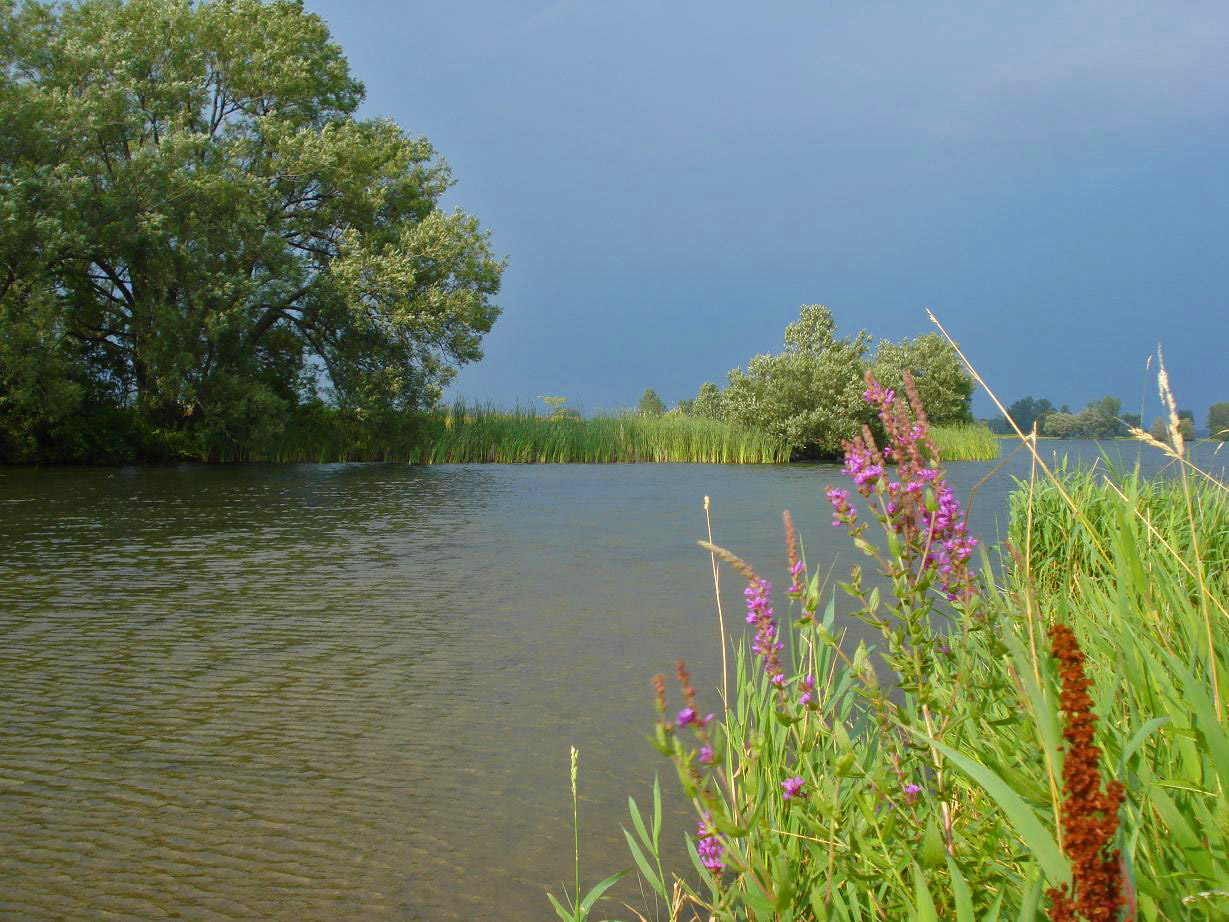
On the second day she reached the great Saint Lawrence River at the remnants of the small village of Iroquois. Julie made out the seaway locks and the dam as she waded through the hummocky wetland of sedges and purple loosestrife. Overgrown and crumbling from disuse, the locks used to control the river’s fluctuating levels and linked the northern shore, once a part of Ontario, Canada, to the south shore that used to belong to New York State in the United States of America. Now it was all simply Icaria’s North Am.

The Iroquois Locks formed part of an extensive navigation system of dams, powerhouses, locks, channels and dikes that made up the St. Lawrence Seaway, linking the Atlantic Ocean to the Great Lakes. Julie imagined the deep-voiced grinding of those locks a hundred years ago, serving the constant traffic of heavy cargo ships and pleasure boats. Now these monoliths languished under a thick mantle of moss and scrub in a quiet breeze, ghosts of a bygone age.
Toulouse and I reached Iroquois just ahead of a looming thunderstorm. We watched a large freighter pass through the lock in the brief sunshine to a dark charcoal colored sky. Lightning blazed and thundered behind us as the ship lumbered along, barely competing with Nature’s power. It was nonetheless impressive. I thought of Julie standing there in the awesome quiet of the place, hearing ghosts…

The Iroquios lock, operated round the clock seven days a week, allows ships to bypass the dam, which controls the level of Lake Ontario. The Iroquios lock is just one part of the extensive Saint Lawrence Seaway system of locks, canals and channels that let ocean-going vessels travel from the Atlantic Ocean to the Great Lakes (as far as Lake Superior) and jointly managed by Canada and the U.S. Started as early as 1783, this series of navigation aids consists of a Montréal to Lake Ontario section, which includes the 33 km South Shore Canal that bypasses the Lachine Rapids (providing a lift of 13.7 m to the level of Lake St. Louis; the 25.9 km Beauharnois Canal with two locks that provide a 25 m lift around the Beauharnois hydroelectric power dam. Another 46.7 km of canal stretches to Cornwall. This is followed by a 70+ km of canals from Cornwall to Prescott and then on to the Iroquios lock on Lake St. Lawrence, which joins to Lake Ontario. Together all the locks between Montréal and Lake Ontario and lift a westbound vessel about 69 m.

The Welland Canal diverts vessels around Niagara Falls, joining Lake Erie and Lake Ontario. The St. Mary’s Canal links Lake Huron to Lake Superior, four parallel locks on the US side that lift westbound vessels 6.4 m to bypass the St. Mary’s rapids.

Next in Julie's journey, the bridge to the United States…


Nina Munteanu is an ecologist and internationally published author of novels, short stories and essays. She coaches writers and teaches writing at George Brown College and the University of Toronto. For more about Nina’s coaching & workshops visit www.ninamunteanu.me. Visit www.ninamunteanu.ca for more about her writing.